- 1. Natural marble vs marble-look tiles
- 2. Where marble-look tiles genuinely win
- 3. Where natural marble is still the better choice
- 4. What separates a good marble-look tile from a bad one
- 5. Glossy or matt
- 6. Where marble-look tiles work, room by room
- 7. What marble-look tiles cost
- 8. Common mistakes
- 9. How to choose
- 10. Frequently asked questions
04 November 2026
Marble vs Tiles: Getting the Marble Look Without the Upkeep

There is a reason marble never quite goes out of fashion. The veining, the depth, the way no two slabs are the same. People do not ask for marble because it is practical. They ask for it because it looks like nothing else.
What has changed is that wanting the marble look no longer means buying natural marble. A good marble-look tile now gets close enough that most visitors to a house will not know the difference, and it behaves very differently once it is down. This guide covers where each one genuinely wins, so you are choosing between two materials rather than assuming one is simply the budget version of the other.
We should be upfront about where we sit: we stock 205 marble-look tile designs and we do not sell natural marble slabs. That is our bias, declared. The sections below still cover where natural stone is the better buy, because sometimes it is.
Natural marble vs marble-look tiles
| Consideration | Natural marble | Marble-look tile |
| Appearance | Genuinely unique, every slab different | Printed designs, repeating after a set number of faces |
| Porosity | Porous | Low water absorption, especially vitrified |
| Sealing | Needed, and repeated over the years | Not required |
| Staining | Vulnerable to oil, turmeric, lemon, wine | Surface is glazed, so stains sit on top |
| Etching | Acids dull the surface permanently | Not affected |
| Installation | Specialist handling, heavier slabs | Standard tiling, any competent tiler |
| Repair | Can be polished back | Replace the affected tile |
| Cost | Higher material and labour | Lower on both |
The honest summary: marble is a metamorphic stone, and the same crystalline structure that produces the veining is what makes it porous and reactive. Water absorption is a measured property graded against Bureau of Indian Standards specifications, so ask for the figure rather than the word. The tile is imitating the appearance, not the material, which is exactly why it does not carry the material's drawbacks, and also why it cannot fully replicate how real stone catches light at depth.
Where marble-look tiles genuinely win
- Indian kitchens. Turmeric, oil and lemon are a daily reality, and all three stain or etch natural marble. A glazed tile shrugs them off.
- Bathrooms. Constant water on a porous stone means sealing on a schedule. A tile needs no such routine.
- Large open floors. Running one continuous look across a living, dining and kitchen area costs far less in tile than in stone.
- Predictable supply. You can order the same design again in six months. You cannot order the same marble slab twice.
- Anywhere a tenant or child is involved. Fewer things to go permanently wrong.
Where natural marble is still the better choice
We would be doing you a disservice pretending otherwise.
- When you want genuine uniqueness. A tile design repeats. A slab does not, and for a statement entrance or a temple, that matters to some people in a way a print cannot satisfy.
- Depth and translucency. Light enters real stone slightly before it reflects. The best prints imitate this well, but up close, in good daylight, a trained eye can tell.
- Carving and edge detail. Marble can be worked, rounded and carved. A tile is a surface with a printed face.
- Heritage and restoration work, where matching existing stone is the whole point.
What separates a good marble-look tile from a bad one
This is the part worth taking time over in the showroom, because the gap between a convincing tile and an obvious one is large.
The number of faces
Cheap ranges print four or six different faces and repeat. Lay them across a room and your eye starts picking out the same vein pattern over and over, which is the single biggest giveaway. Better ranges run to dozens of faces. Ask how many the range has before anything else.
Vein scale
Veining that is correctly scaled runs across tile joints as though the stone continues underneath. Veining scaled too small reads as a pattern printed on squares, because that is what it is.
Print resolution and depth
Hold the tile at an angle under light. A good porcelain or vitrified tile has some visible depth to the vein rather than a flat printed line sitting on the surface.
Format
Larger formats are more convincing, because fewer joints means fewer interruptions to the illusion. Most of our marble-look range is 600x1200 mm, with 32 designs at 1200x1800 mm and 15 full slabs at 1200x2400 mm for walls that need to run almost joint-free.
Bookmatching
Some ranges are designed so two tiles mirror each other, producing the butterfly effect you see in real stone slabs. Worth asking about if you are tiling a feature wall rather than a floor.
Glossy or matt
Our marble-look range splits almost evenly: 101 glossy designs and 83 matt, plus a handful of textured matt finishes.
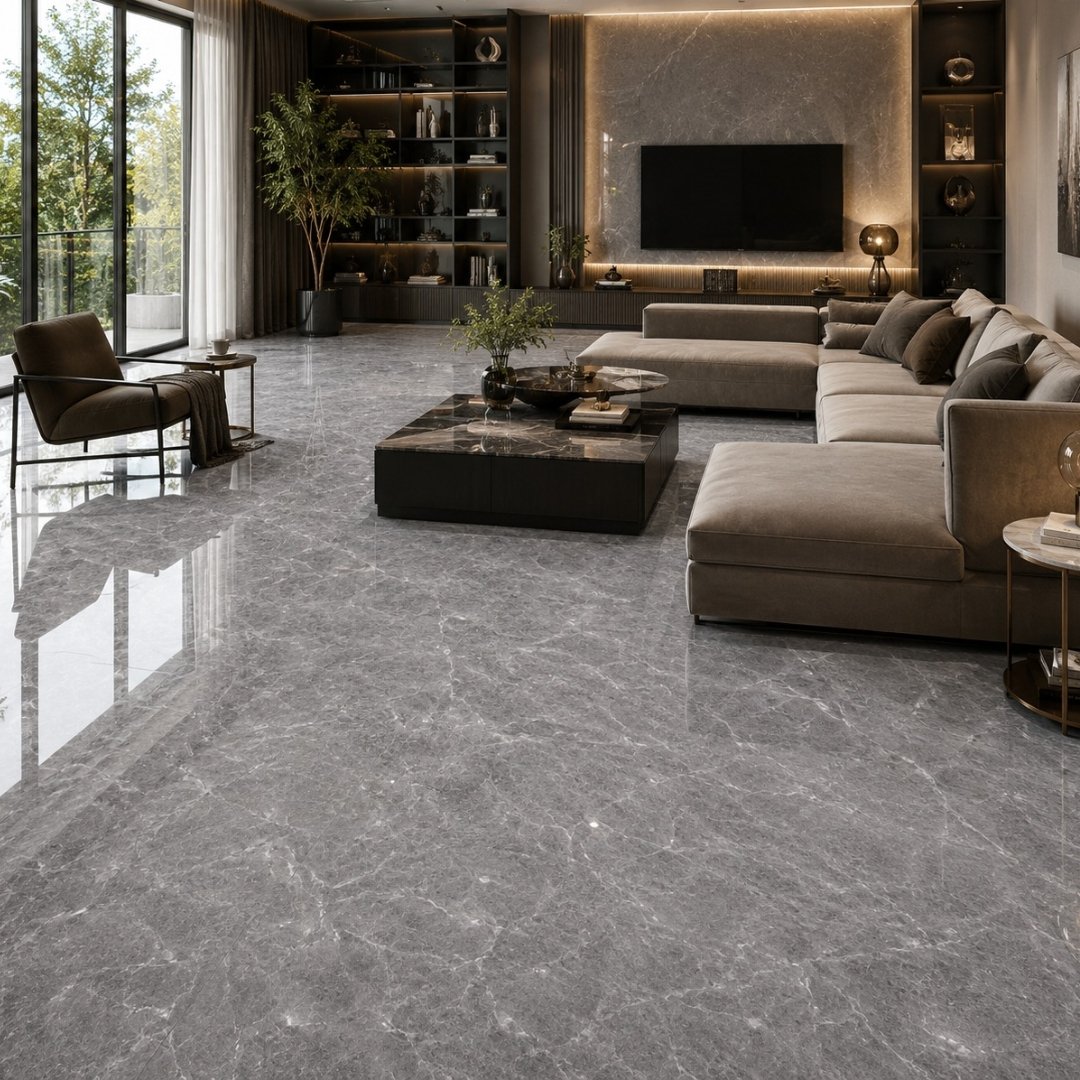
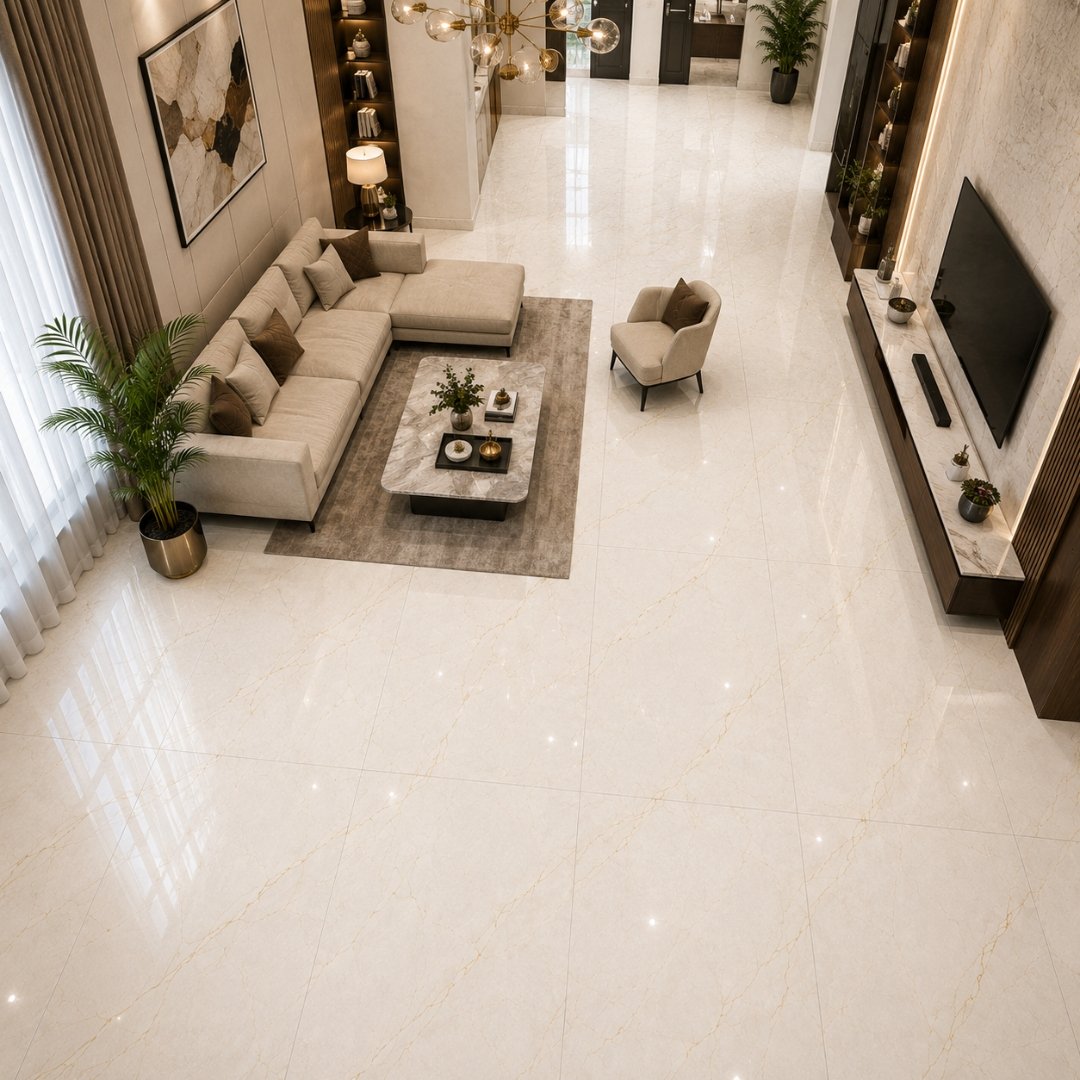
- Glossy is closer to polished marble and reflects light, which suits living and dining floors and makes a space feel larger. It also shows footmarks and dust sooner.
- Matt reads closer to honed stone, hides daily marks and gives better grip underfoot.
For bathroom floors, choose matt or textured regardless of how good the gloss looks dry, and check the rating in our anti-skid guide. Our matt versus glossy comparison covers the trade-off room by room.
Where marble-look tiles work, room by room
- Living and dining floors. Our largest marble-look range, with 65 designs in the living area marble and stone collection. Glossy large format is the common choice here.
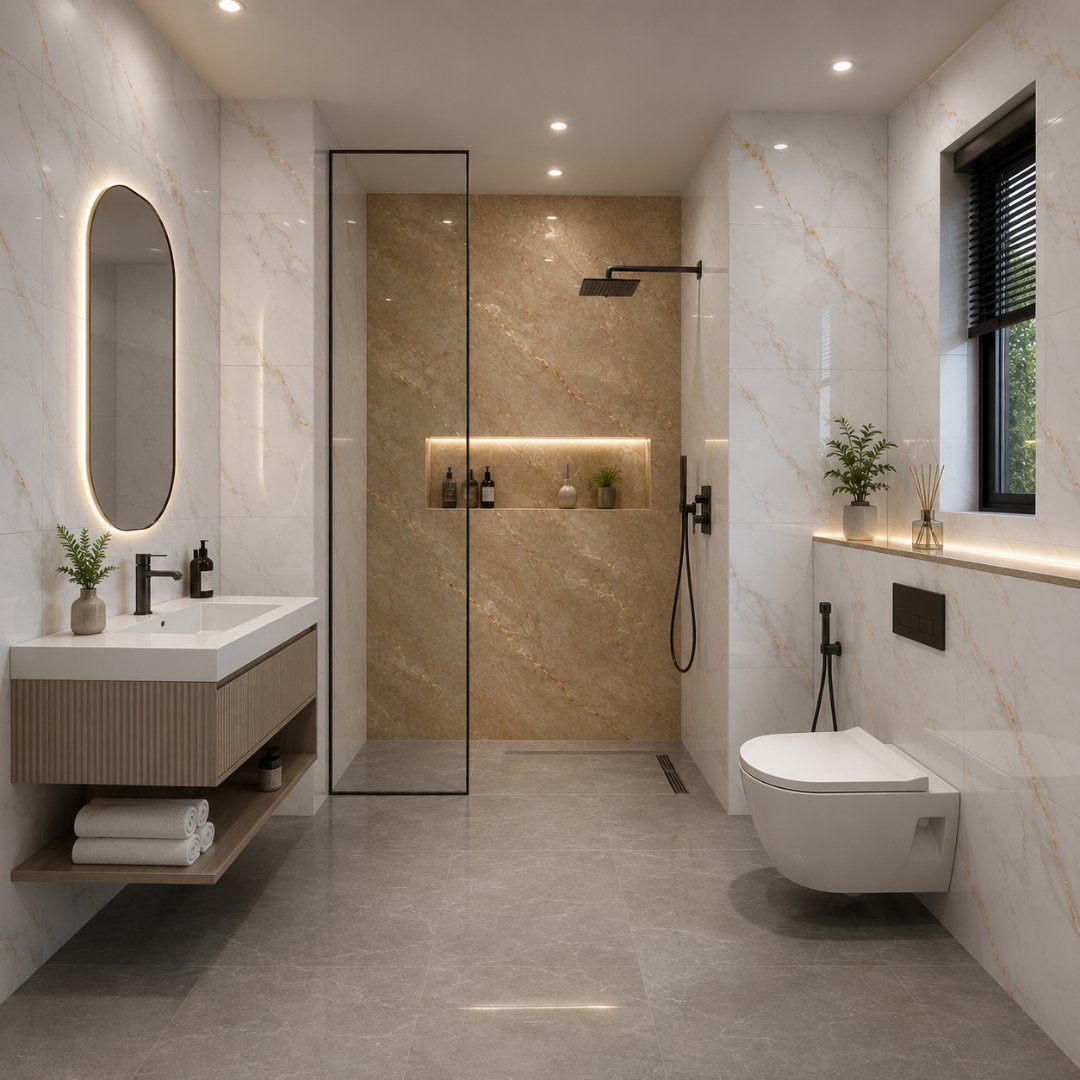
- Bathroom walls. 88 designs in the bathroom marble wall tiles range, the most popular use of marble-look in Indian homes.
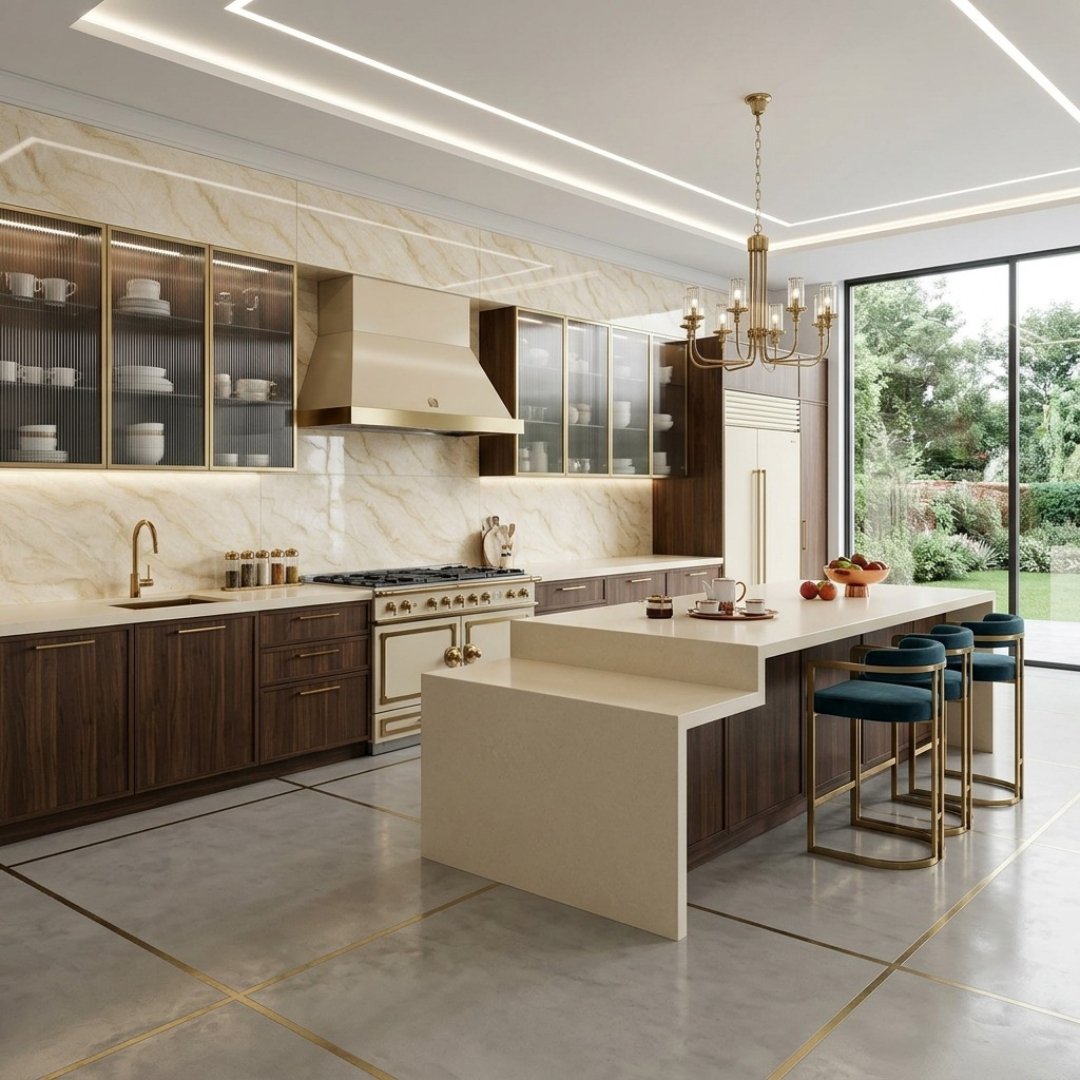
- Kitchen floors. 23 designs in the kitchen marble and stone range, and the room where the stain resistance earns its keep.
- Bathroom floors. 9 designs in bathroom marble and stone, matt finishes only.
- Feature walls. Large format or bookmatched slabs behind a bed, a TV unit or a vanity.
If you are planning a bathroom with marble-look as the feature, our bathroom tiles combination guide covers what to pair it with, and the bathroom wall tiles design guide covers the wider range of styles.
What marble-look tiles cost
Across our marble-look range, the designs we publish prices for run from ₹65 to ₹221 per sq ft, with most sitting between ₹65 and ₹145. Large-format slabs and the better-printed premium ranges occupy the top of that band.
Natural marble in Bangalore generally starts higher and climbs considerably with quality, before you add the installation premium for specialist handling and the ongoing cost of sealing. The gap over a whole floor is usually substantial, which is the practical reason most homeowners we see end up choosing the tile.
Two costs people forget either way: cutting waste, which rises with large formats, and skirting. Our tile sizes guide covers the quantity calculation.
Common mistakes
- Not asking how many faces the range has. The most common reason a marble-look floor ends up looking fake.
- Choosing from a single sample tile. One tile tells you nothing about repetition. Ask to see several laid together.
- Glossy marble-look on a bathroom floor. It is a genuine slip risk once wet.
- Mixing two marble designs in one room. Real stone in one space comes from one quarry. Two different marble prints look like a mistake.
- Expecting it to carve. If your design needs rounded edges or a moulded profile, you need stone, not tile.
How to choose
- Decide the room and whether it is floor, wall or both.
- Ask how many faces the range carries, and see several tiles laid together.
- Pick the finish: glossy for living areas, matt for bathrooms and anywhere wet.
- Go as large as the room and the wall flatness allow.
- Check the vein scale works across joints, not just within one tile.
- Confirm quantity including cuts and skirting before ordering.
For how vitrified compares with ceramic on water absorption and strength, our vitrified versus ceramic guide covers it. Most of our marble-look range, 170 of 205 designs, is vitrified.
Come to our BTM Layout showroom and ask us to lay six tiles from the same range on the floor together. That one test tells you more about a marble-look tile than any amount of looking at a single sample.
Frequently asked questions
Which is better, marble or tiles?
For most Indian homes, marble-look tiles are the more practical choice, because they do not stain from turmeric, oil or lemon, need no sealing and cost less to buy and lay. Natural marble is better when you want genuine slab uniqueness, real depth up close, or carved and moulded edge detail.
Do marble-look tiles look fake?
Cheap ones do, and the reason is almost always the number of printed faces. A range with only four or six faces repeats visibly across a floor. Ranges with dozens of faces, correctly scaled veining and a large format are difficult to identify as tile from normal standing distance.
Do marble tiles need sealing like natural marble?
No. Glazed vitrified and porcelain marble-look tiles have a sealed surface and very low water absorption, so they need no sealing at any point. Natural marble is porous and needs sealing on installation and periodically after.
Are marble-look tiles good for Indian kitchens?
Yes, and this is where they have the clearest advantage. Turmeric, oil, lemon and other acidic foods stain or etch natural marble permanently, while a glazed tile surface resists all of them and wipes clean.
What size marble-look tile should I choose?
Larger is generally more convincing, since fewer joints mean fewer breaks in the veining. 600x1200 mm is the most common choice and what most of our range comes in, with 1200x1800 mm and full 1200x2400 mm slabs available where the wall or floor is large enough and flat enough to take them.
How much do marble-look tiles cost in Bangalore?
The designs we publish prices for run from ₹65 to ₹221 per sq ft, with most falling between ₹65 and ₹145. Large formats and premium printed ranges sit at the upper end, and some of the range is quoted on request depending on size and finish.
Can marble-look tiles be used on walls and floors together?
Yes, and running the same design up a feature wall and across the floor is a common way to get a continuous stone effect. Use a matt or textured version underfoot in wet areas even when the wall version is glossy, since the floor needs the grip.